Chemical Segregation

When laboratory chemicals are not in active use there are general storage considerations for chemical storage locations.

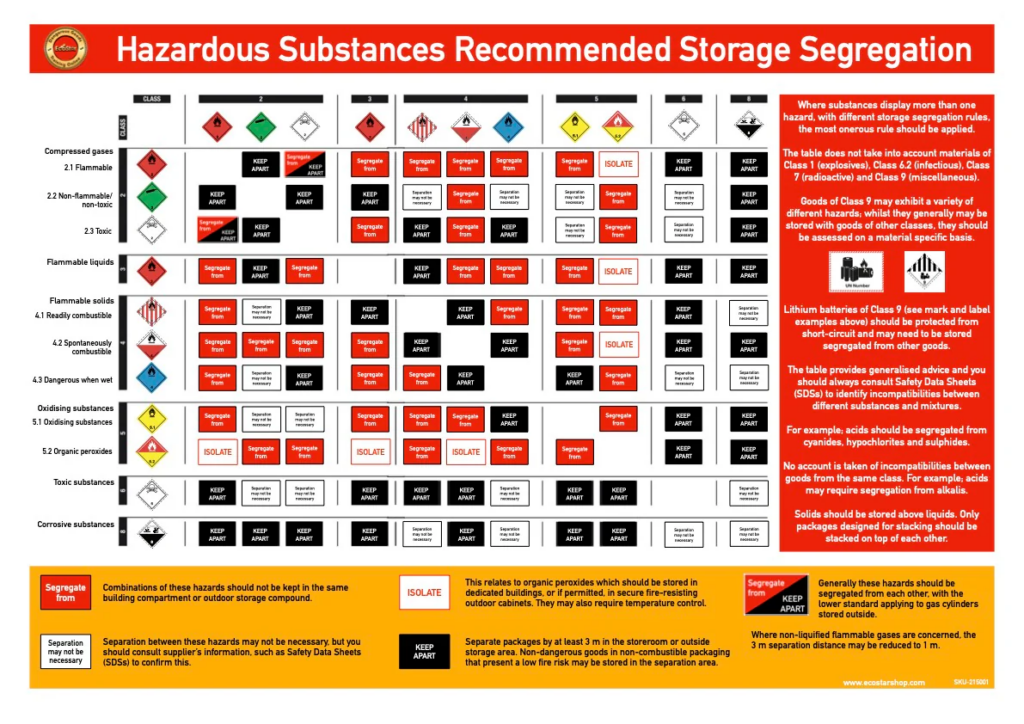
When certain hazardous chemicals are stored or mixed together, violent reactions may occur because the chemicals are unsuitable for mixing, or are incompatible. Classes of incompatible chemicals should be segregated from each other during storage, according to hazard class. This will serve to reduce the risk of mixing in case of accidental breakage, fire, or response to a laboratory emergency. Even when containers are tightly closed, fugitive vapors can contribute to incompatibility reactions, leading to the creation of a hazardous condition or accelerate the degradation of labels, shelves, cabinets, and the containers themselves. Use the following general guidelines for hazard class storage:
Applicable Policies and Guides

Flammable chemicals must be stored in certified flammable cabinets away from any heat or ignition sources at the end of each work day. There may not be greater than 10 gallons of flammable chemicals outside a flammable cabinet at any given time. Flammable liquids should be stored separately from strong oxidizers, shielded from direct sunlight and away from heat sources.

Flammable and Combustible Liquids

  • Flammable and combustible liquids vaporize and form flammable mixtures with air when in open containers, when leaks occur, or when heated. To control these potential hazards, several properties of these materials, such as volatility, flashpoint, flammable range and autoignition temperatures must be understood. Information
  • When working with open containers, use a laboratory fume hood to control the accumulation of flammable vapor.
  • Do not heat flammable liquids with an open flame.

Flammable Aerosols

  • Flammable liquid in pressurized containers may rupture and aerosolize when exposed to heat, creating a highly flammable vapor cloud.

Flammable and Combustible Solids

  • Flammable solids often encountered in the laboratory include alkali metals, magnesium metal, metallic hydrides, some organometallic compounds, and sulfur. 
  • Many flammable solids react with water and cannot be extinguished with conventional dry chemical or carbon dioxide extinguishers. Ensure class D extinguishers are available where flammable solids are used or stored. Sand can usually be used to smother a fire involving flammable solids. 
  • NEVER use a carbon dioxide fire extinguisher for fires involving lithium aluminum hydride (LAH).
  • When working with open containers, use a laboratory fume hood to control the accumulation of combustible dust. 

Applicable Policies and Guides

Many chemicals commonly used in the laboratory are corrosive or irritating to body tissue. They present a hazard to the eyes and skin by direct contact, to the respiratory tract by inhalation or to the gastrointestinal system by ingestion. Storage of these materials should be kept inside of a corrosive cabinet.

Corrosive Liquids

  • Corrosive liquids represent a very significant hazard because skin or eye contact can readily occur from splashes and their effect on human tissue generally takes place very rapidly.
  • It is essential that eye and face protection are worn in all laboratories where corrosive chemicals are handled.
  • Gloves and other chemically resistant protective clothing should be worn to protect against skin contact.
  • To avoid a flash steam explosion due to the large amount of heat involved, always add acids or bases to water (and not the reverse).
  • Acids and bases must be segregated for storage.

Corrosive Gases and Vapors

  • Corrosive gases and vapors are hazardous to all parts of the body; certain organs are particularly sensitive. Highly soluble gases (ex. Ammonia, hydrogen chloride) cause severe nose and throat irritation, while substances of lower solubility (ex. nitrogen dioxide, phosgene, sulfur dioxide) can penetrate deep into the lungs.
  • Regulators and valves should be closed when the cylinder is not in use and flushed with dry air or nitrogen after use. Perform manipulations of materials that pose an inhalation hazard in a chemical fume hood to control overexposure or wear appropriate respiratory protection.

Corrosive Solids

  • Corrosive solids (ex. sodium hydroxide and phenol) can cause burns to the skin and eyes.
  • Dust from corrosive solids can be inhaled and cause irritation or burns to the respiratory tract. 
  • Many corrosive solids (ex. potassium hydroxide and sodium hydroxide) can produce considerable heat when dissolved in water.
  • Wear gloves, a lab coat, and eye protection when handling corrosive solids.
  • When mixing with water, always slowly add the corrosive solid to water, stirring continuously. Cooling may be necessary.
  • If there is a possibility of generating a significant amount of dust, conduct work in a fume hood. 

Applicable Policies and Guides

A cryogenic liquid is defined as a liquid with a boiling point below -100F (-73C). Liquid nitrogen, liquid oxygen and carbon dioxide are the most common cryogenic materials used in the laboratory. Hazards of these materials may include fire, explosion, embrittlement, pressure buildup, frostbite and asphyxiation. Vaporization of cryogenic liquids (except oxygen) in an enclosed area can cause asphyxiation. Vaporization of liquid oxygen can produce an oxygen-rich atmosphere, which will support and accelerate the combustion of other materials. Vaporization of liquid hydrogen can form an extremely flammable mixture with air. Most cryogenic liquids are odorless and colorless when vaporized. When cryogenic liquids are exposed to the atmosphere, the cold boil-off gases condense the moisture in the air, creating a highly visible fog.

When handling cryogenic liquids:

  • Always handle these liquids carefully to avoid skin burns and frostbite.
  • Boiling and splashing always occurs when charging or filling a warm container with cryogenic liquid or when inserting objects into these liquids. Perform these tasks slowly to minimize boiling and splashing. Use tongs to withdraw objects immersed in a cryogenic liquid.
  • Never touch uninsulated pipes or vessels containing cryogenic liquids. Flesh will stick to extremely cold materials.
  • Use wooden or rubber tongs to remove small items from cryogenic liquid baths. Cryogenic gloves are for indirect or splash protection only, they are not designed to protect against immersion into cryogenic liquids.
  • Cylinders and dewars should not be filled to more than 80% of capacity, since expansion of gases during warming may cause excessive pressure buildup.
  • PPE and protective clothing are necessary when handling cryogenic liquids. Face shields must be worn with safety glasses or chemical splash goggles during transfer and handling of cryogenic liquids. Insulated cryogenic gloves must be worn when handling objects that come into contact with cryogenic liquids and vapor.

Simple asphyxiants are substances or mixtures that displace oxygen in the ambient atmosphere, and can thus cause oxygen deprivation in those who are exposed, leading to unconsciousness and death. All asphyxiants should be stored and used in well-ventilated areas, such as within chemical fume hoods. Closets and small rooms should be avoided to prevent the displacement of oxygen. 

Applicable Policies and Guides

Reactive compounds can often react unpredictably with extreme force. Condensation via evaporation or distillation, heat, shock, or friction can all lead to a sudden reaction. Exposure to air or water may cause instantaneous combustion. Examples of highly reactive compounds in laboratories are peroxide forming compounds and pyrophoric compounds.


Peroxide Forming Compounds
Peroxide forming compounds can become dangerous by forming dangerous peroxides when exposed to air and light. Peroxides may also detonate with extreme force when concentrated by evaporation or distillation, when combined with other compounds, or when disturbed by unusual heat, shock, or friction. Formation of peroxides is accelerated in opened or partially emptied containers.

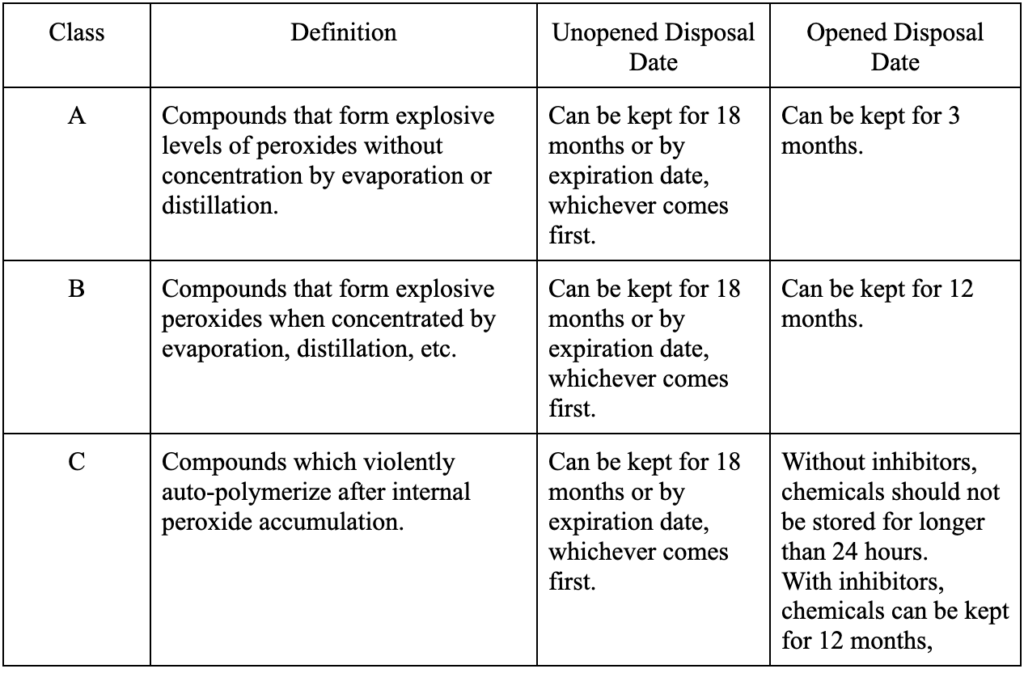
  • Peroxide forming chemicals should be used or disposed of prior to the expiration date.
  • Evaluate chemicals for peroxide formation regularly and always prior to distillation. This can be done by seeing if the chemical is cloudy or has crystal formation.
  • Label containers with the date received, the date first opened and the date for disposal as recommended by the manufacturer.
  • Do not concentrate solutions that may contain peroxides.
  • Do not use metal spatulas or magnetic stirring bars with peroxide forming compounds, since contamination with metals can lead to explosive decomposition.
  • There are three classes of peroxide forming compounds, Class A, Class B, and Class C. Each class has different disposal timelines.

Pyrophoric Reagents
Pyrophoric reagents are extremely reactive toward oxygen and in most cases, water, and must never be exposed to the atmosphere. All combustible material, including paper products, should not be allowed to come in contact with any pyrophoric reagent at any time. Exposure to these reagents to air could result in spontaneous combustion, which could cause serious burns or other injuries to the person handling the reagents or others in the immediate area.

  • Handling of pyrophoric reagents should be conducted without exposure to atmospheric oxygen and moisture.
  • Solid pyrophoric materials must be transferred under an inert atmosphere in an efficient glove box.
  • Glass bottles of pyrophoric reagents should not be handled or stored unprotected. The metal can shipped with each bottle should be retained as a protective container for each bottle for transporting and storage.
  • Ensure glassware is DRY before assembly and introducing pyrophoric materials.
  •  Never work with pyrophoric materials alone.
  • Powdered lime should be available when working with pyrophoric materials, this can be used to cover spills and slow the reaction with air/humidity. Do not clean up spills, contain the spill and/or extinguish the fire only if you can do so safely. Evacuate the lab and contact EH&S or GUPD immediately.

 
Applicable Policies and Guides
Laboratory Safety Manual – (Link when document goes live)
29 CFR 1910.1450 (OSHA Laboratory Standard)

Compressed gas cylinders contain varying pressures of inert, toxic, flammable, oxidizing, corrosive, or combination of gases. Care in using, handling, and storing compressed gas cylinders are required due to the high potential for severe incidents.

When storing compressed gas cylinders:

  • Cylinders must be secured to a stationary object or wall. No more than two cylinders may be fastened by one strap.
  • Store or move cylinders with safety caps in place.
  • Cylinders of toxic, flammable, or reactive gases should be used and stored in fume hoods if possible.
  • Store compressed gas cylinders away from heat sources, and flammable and highly combustible materials.
  • Store flammable compressed gas cylinders separately from oxidizing and toxic compressed gas cylinders.

When using compressed gas cylinders:

  • Cylinders must be strapped to a designated cylinder transport wheeled cart to ensure stability during transport.
  • Elevators can be a confined space, NEVER ride in an elevator with compressed gas cylinders. Have one person send the elevator and another person receive the elevator.
  • Never use a cylinder that cannot be positively identified.
  • Use the appropriate pressure regulator and rated tubing to dispense gas.
  • Close cylinder and bench valves tightly when not in use. Label empty cylinders as “empty”.
  • NEVER dispose of gas cylinders in the general waste stream.

Applicable Policies and Guides