General Laboratory Safety
Environmental Health & Safety (EH&S) is responsible for maintaining a safe teaching, research, and work environment at Georgetown University. EH&S provides University-wide oversight and technical expertise for the identification, evaluation, and control of chemical, biological, radiological, and physical hazards in GU buildings and laboratories.
EH&S develops and administers programs that implement University policies and procedures to protect the health and safety of students, faculty, staff, and visitors, and to ensure compliance with applicable federal, state, and local regulations, including OSHA, EPA, NFPA, and related regulatory authorities.
Laboratory Inspection Program
EH&S inspects each laboratory and laboratory support room annually. Inspections are performed in accordance with government regulations and funding agency stipulations, and are used to address safety issues identified in the laboratory. The IACUC conducts facility inspections twice a year to evaluate the effectiveness of control measures in place to reduce the risk of injury and illness of personnel working with or near laboratory or research animals. EH&S inspections also serve to prepare laboratories for inspections from outside agencies as needed.
EH&S inspections examine laboratory entrance and egress, documentation, housekeeping and facility design, emergency equipment/supplies, PPE, fume hoods, chemical safety, biological safety, radiation safety, laboratory waste, as well as electrical and mechanical and fire safety. A list of the laboratory safety inspection categories is available on the EHS website.
Laboratory Risk Assessment
Laboratory risk assessment is the foundation of safe research at Georgetown University. Before work begins—and whenever procedures, materials, equipment, or personnel change—laboratories must evaluate the hazards associated with their activities and determine appropriate controls. This includes identifying chemical, biological, physical, and equipment-related hazards; assessing the likelihood and severity of potential exposures; and implementing controls using the established hierarchy of controls, including engineering controls, administrative controls, and personal protective equipment. Principal Investigators are responsible for ensuring that risk assessments are completed, documented when required, and communicated to all laboratory personnel. EH&S supports this process through protocol review, laboratory inspections, and consultation. Effective risk assessment prevents incidents, supports regulatory compliance, and ensures research is conducted responsibly and safely.
Hazard Communication
Georgetown University’s Hazard Communication program ensures that anyone who works with or may be exposed to hazardous chemicals understands the hazards, proper handling, and protective measures required under the OSHA Hazard Communication Standard (29 CFR 1910.1200). At its core, this program delivers on the federal “Right to Know” obligation: hazardous chemicals must be properly labeled, Safety Data Sheets (SDSs) must be accessible for every chemical in your work area, and all personnel must receive training before initial assignment and whenever new hazards are introduced. Labels must accurately identify the chemical contents, and SDSs — provided by manufacturers — must be kept in a location known and accessible to lab personnel. Each laboratory must maintain an up-to-date chemical inventory and ensure that hazard information is communicated effectively through labeling, documentation, and training. Principal Investigators and supervisors are responsible for implementing Hazard Communication requirements in their spaces, and EH&S supports compliance through training, consultation, and oversight.
Personal Protective Equipment (PPE) in Laboratories
Personal Protective Equipment (PPE) is a critical control measure used to protect laboratory personnel from chemical, biological, physical, and mechanical hazards when engineering and administrative controls alone cannot eliminate risk. At Georgetown University, appropriate PPE must be worn at all times while working in laboratories where hazardous materials or processes are present. Required PPE is determined through laboratory risk assessment and may vary based on the work being performed. At a minimum, proper laboratory attire includes a fully buttoned lab coat, safety glasses or goggles, long pants that cover the legs to the ankles, and closed-toe, closed-heel shoes made of durable material. Gloves must be selected based on the specific hazard and changed regularly. PPE must be maintained in good condition, worn correctly, and removed before leaving the laboratory to prevent the spread of contamination. Principal Investigators and supervisors are responsible for ensuring that appropriate PPE is available and that laboratory personnel are trained on its proper use. EH&S provides guidance on PPE selection, use, and compliance.
PPE Non-Compliance and Enforcement
Proper use of Personal Protective Equipment is mandatory in Georgetown University laboratories. Individuals observed working without required PPE may be instructed to stop work immediately until compliance is achieved. Repeated or willful non-compliance may be escalated to the Principal Investigator, department leadership, and EH&S for corrective action. PPE requirements are not optional and are a condition of laboratory access and authorization to work.
Proper Laboratory Attire (Quick Reference)
Proper laboratory attire is required whenever hazardous materials or equipment are present, even for brief tasks. Clothing and footwear must provide adequate protection against spills, splashes, sharps, and dropped objects. Personal items such as loose jewelry, scarves, and dangling accessories must be secured or removed to prevent entanglement or contamination.
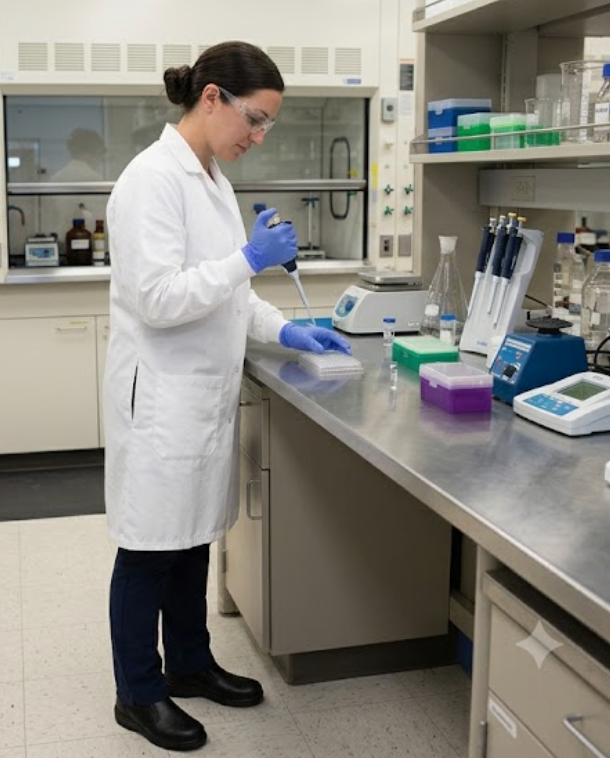
PPE Do’s and Do Not’s in Laboratories
- Wear a fully buttoned lab coat when working with hazardous materials
- Wear safety glasses or chemical splash goggles appropriate to the hazard
- Wear long pants that fully cover the legs to the ankles
- Wear closed-toe, closed-heel shoes made of sturdy, non-absorbent material
- Select gloves compatible with the specific chemical or biological hazard
- Remove gloves and lab coats before leaving the laboratory
- Wear shorts, skirts, cropped pants, or leggings
- Wear sandals, ballet flats, Crocs, mesh shoes, or open-heel footwear
- Roll up sleeves or leave lab coats open while working
- Wear PPE outside of the laboratory (hallways, offices, restrooms)
- Assume one type of glove protects against all hazards
Failure to comply with PPE requirements may result in work stoppage and corrective action.