Animal Research Health and Safety
The Animal Research Health and Safety Program provides guidance and information on controlling your exposure to hazards while conducting studies involving animal models.
Administration of Biological and Chemical Hazards to Research Animals
The administration of biological and chemical hazards to laboratory animals requires careful planning to prevent uncontrolled exposures for research, veterinary and animal husbandry staff. It is the Principal Investigator’s responsibility to notify DCM staff prior to administering hazards. Prior notification provides time needed to educate students and staff involved in the care of the research animals on the precautions required to prevent exposure and inadvertent release of hazards into the environment.
Administration of Chemical Hazards to Research Animals
Your research may involve the controlled administration of Particularly Hazardous Substances (PHS), that include antineoplastic drugs, toxins and other chemicals to animal models. These guidelines provide information on decreasing your potential for exposure to a variety of potentially hazardous materials.
- MS-222 Guide
- PHS in animals policy
- Tier 1 (Black) Hazardous Chemicals SOP
- Tier 2 (Purple) Hazardous Chemicals SOP
Safe use of Isoflurane in Animal Research
Isoflurane is a commonly used halogenated anesthetic in animal research at Georgetown University. Researchers can be exposed, via inhalation, to waste anesthetic gases (WAG), including isoflurane, if care is not taken to scavenge or prevent release into the laboratory environment.
Although the relationship between overexposure to isoflurane and adverse health effects is not well-defined, most references in the occupational health literature recommend precautions to control exposure during veterinary and research-related surgical procedures. These precautions include adequate general ventilation in the surgical areas, the use of well-designed and well-maintained scavenging systems, work practices to minimize leaks and spills while the anesthetic agent is in use, and routine equipment maintenance to minimize leaks.
Always consult with DCM veterinarians if you have animal care concerns related to the use of halogenated anesthetic gases.
Reducing Exposure to Anesthetic Gases
Use anesthetic gases in a laboratory equipped with adequate ventilation. Georgetown University laboratories are designed to provide a minimum of 6 air changes per hour (ACH). Our animal procedure labs provide 10 or more ACH. As with all hazardous chemicals, consult with Environmental Health and Safety (EHS) if you plan to use isoflurane or any other anesthetic gas outside of a laboratory.
Several methods to capture or scavenge WAG are available:
- Chemical Fume Hood or Ducted (Exhausted) Biosafety Cabinet : A chemical fume hood or hard-ducted biosafety cabinet provides excellent protection from exposure to WAG. Hard-ducted biosafety cabinets are available in DCM animal facilities. If you administer isoflurane or other halogenated anesthetics within a chemical fume hood or ducted biosafety cabinet, you do not need to use a charcoal absorption canister. Chemical fume hoods and biosafety cabinets must be tested annually to ensure proper operation. Contact EHS for assistance. Recirculating biosafety cabinets do not exhaust or remove WAG or other hazardous gases or vapors from the laboratory environment.
- Downdraft tables, snorkel exhausts, ventilated chambers: Snorkel trunks, exhausted induction chambers, ventilated chambers, down draft tables, when connected to the building exhaust system, can prevent overexposure to WAG. Devices connected to the exhaust system should be tested annually. Charcoal canisters must be used to adsorb isoflurane or other halogenated anesthetics.
- Waste Gas Scavenging (when local ventilation is not available): Active systems: House vacuum system, with proper flow control, extracts waste gas from the anesthesia set up and discharges it outside of the building. Activated carbon canisters must be used to remove the waste anesthesia gas. Passive systems do not use local ventilation or vacuum to actively remove the waste isoflurane. Charcoal canisters must be used to adsorb isoflurane or other halogenated anesthetics when working with a passive system. Connect one charcoal canister to the anesthesia set up and another to the induction chamber.
Charcoal Canisters
Canisters should be positioned upright, not horizontally.
Record the baseline weight directly on the canister. After each use or before next use, weigh and record the value on the canister. Note that manufacturer’s guidelines must be followed in regard to weight limits, and that canisters must be discarded through EHS once it reaches those limits.
Safe Work Practices
Before using anesthetic gas:
- Vaporizer should be inspected annually.
- Verify that the chemical fume hood, ducted biosafety cabinet or ventilation system has been checked within the last year.
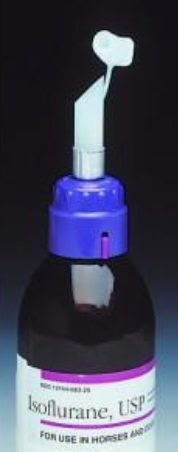
- Fill the vaporizer in a chemical fume hood, if available. Always use an anti-spill adaptor. Wear a lab coat, disposable nitrile gloves and eye protection.
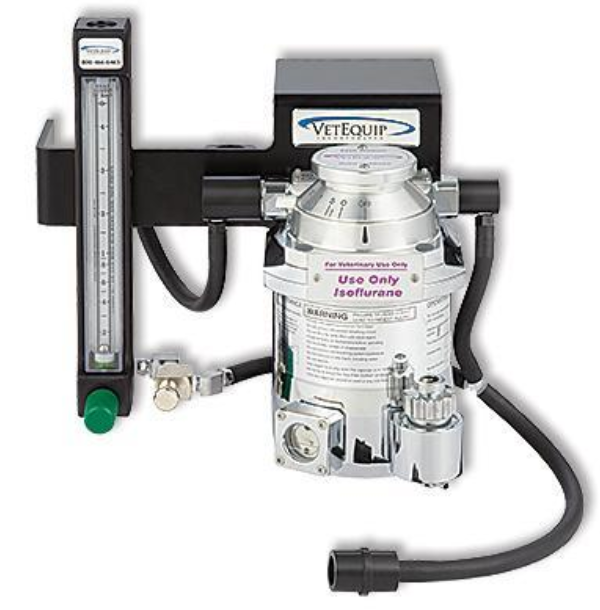
- Verify that the chemical fume hood, ducted biosafety cabinet or ventilation system has been checked within the last year.
- Fill the vaporizer in a chemical fume hood, if available. Always use an anti-spill adaptor. Wear a lab coat, disposable nitrile gloves and eye protection.
- Use the lowest concentration of anesthetic gases needed.
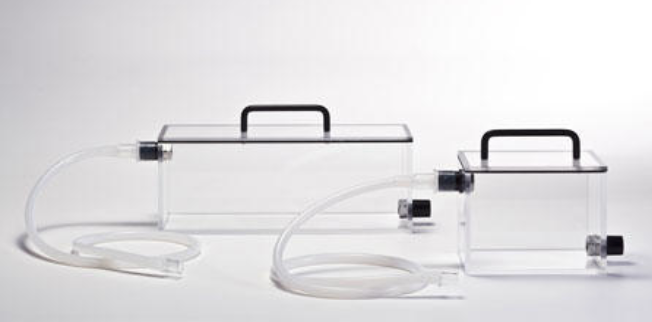
- Whenever possible, place the induction chamber in a fume hood or ducted biosafety cabinet. If a fume hood or ducted biosafety cabinet is not available, attach a charcoal canister to the exhaust port.
- Place the animal in the induction chamber and then turn on the vaporizer.
- Purge the induction chamber with oxygen prior to opening the chamber to retrieve the anesthetized animal.
Disposal
- Contact EHS to arrange for pick up and disposal of unused or expired anesthetic liquids. Do not dispose of liquid into the drain or regulated medical waste receptacles.
- Used charcoal canisters must be bagged and disposed of by submitting a waste request to EHS. Do not dispose into regulated medical waste.
Isoflurane Exposure Limits
The Occupational Safety and Health Administration (OSHA) has not issued a Permissible Exposure Limit for isoflurane. However, the National Institute for Occupational Safety and Health Administration (NIOSH) recommends that no worker should be exposed at ceiling concentrations greater than 2 ppm to any halogenated anesthetic agent over the course of 60 minutes. This exposure limit is based on the health effects attributed to halothane and methoxyflurane and has been extended by NIOSH to include newer halogenated agents such as isoflurane.
The American Conference of Governmental Industrial Hygienists (ACGIH) has set an 8 hour exposure concentration for enflurane at 75 ppm. Isoflurane is a structural isomer of enflurane.
Administration of Biological Hazards to Research Animals
The administration of biohazards to animals requires careful coordination among the research staff, DCM employees and EHS. Georgetown University Institutional Biosafety Committee (IBC) reviews and approves work with recombinant nucleic acid molecules and biohazardous materials. As well as, IBC establishes biocontainment for research involving administration of these materials to research animals.
The Georgetown University Biological Safety Manual contains a summary of Animal Biosafety Levels 1 and 2.
Zoonotic Disease Information
Interactions with animals can pose a risk for zoonoses, diseases of animals that can be transferred to humans. Often, the animal shows little, if any, sign of illness. The fact sheets on this page provide information on how to prevent transmission of zoonotic diseases associated with laboratory animals.
If you suspect that you have sustained an exposure to a zoonotic disease, contact Occupational Health.
Zoonotic Guides:
- Prevention of Allergies and Asthma in Animal Handlers Guideline
- Zoonoses Associated with Fish and Amphibians
- Zoonoses Associated with Laboratory-reared Rodents
- Zoonoses Associated with New World Nonhuman Primates
- Zoonoses Associated with Old World Nonhuman Primates
- Zoonoses Associated with Swine
- Zoonoses Associated with Wild Rodents
- Zoonoses Associated with Wild Birds
- Zoonoses Associated with Zebrafish
Additional Resources
- American Biological Safety Association Risk Group Database
- Biosafety in Microbiological and Biomedical Laboratories, 6th Edition
- NIH Guidelines for Research Involving Recombinant DNA Molecules
- OSHA Bloodborne Pathogens (BBP) Standard
Medical Clearance for Animal Researches
Link to Occupational Health Website